
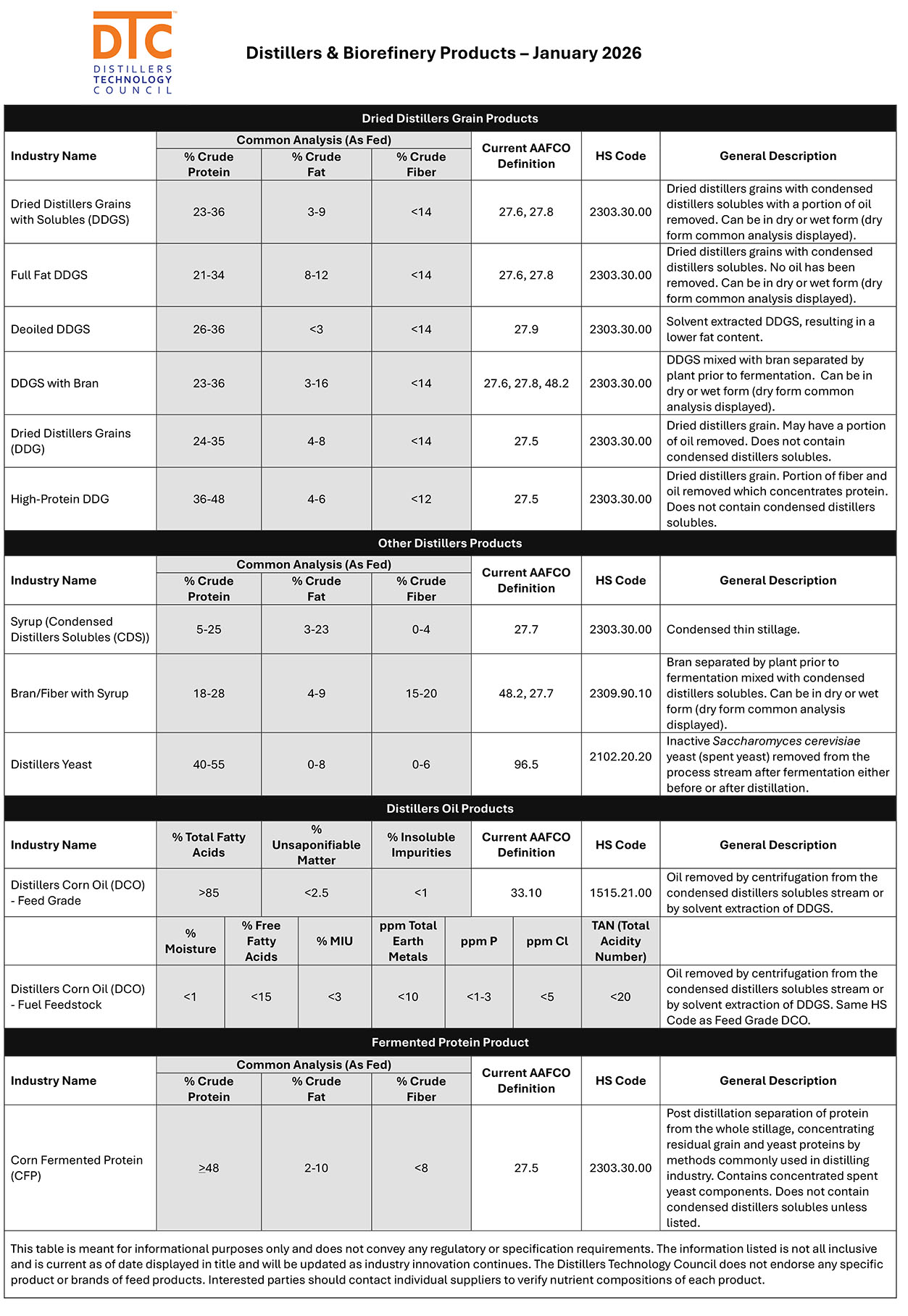
The DTC has developed this table to help clarify and summarize commercially available distillers and biorefinery products in the marketplace. Values expressed in this table are meant to serve as an approximation of common nutritional analyses found in the industry. Actual values will be dependent upon multiple variables present within the U.S. alcohol and biorefinery industries, such as geographic location, grain nutrient composition, production processes used, ethanol and feed product yields. These feed products may be available in liquid, wet, dry, meal, pellet, or cube forms within your region. We recommend you discuss with your industry suppliers to understand the quality, availability, and nutrient guarantees for specific products, as these will impact use in your species of interest. As new materials become available in the marketplace, this information may be updated accordingly, pending DTC board approval.
Recorded Webinars
Virtual Symposium 2020 – Session 3 – YouTube
Virtual Symposium 2020 – Session 2 – YouTube
Virtual Symposium 2020 – Session 1 – YouTube
Availability
Distillers dried grains is readily available all year with some dry-mill distillers processing 50-250 thousand bushels of grain per day. For each 1,000 bushels of grain 8-9 tons of distillers dried grains with solubles (DDGS) is produced. Truck, railroad, river barge and ocean delivery are now being utilized to transport the product. Information and sources of supply are available from Distillers Technology Council (DTC), whose members produce consistent high quality products.
Today distillers grains is predominantly sold commercially as distillers dried grains with solubles (DDGS). This is a stable, free-flowing granular product that is yellow/tan to brown in color with a bulk density of 30-40 pounds per cubic foot. Product color may vary, but several animal studies have shown that color is not an indicator of nutritional quality. DDGS with a uniform moisture (8-12%), properly cooled and stored in a cool, moisture free location has a long storage life.
Nutritional Studies
For over 50 years, DTC has funded numerous nutritional and application research studies at prestigious universities on utilization of distillers grains in all animals, but predominantly ruminant animals, and including human foods. Consistently, scientific researchers have demonstrated that distillers grains is an excellent, all natural, low cost source of energy, protein (180 PER compared to soybean meal), vitamins and minerals and is an especially superior source of bypass protein for ruminants. DTC has this information available and will provide it to potential users of distillers grains.
Processing
Distillers Grains Processing – PDF
BioEnergy “Two-For”
Storage
Best Practices for Handling and Storing Wet Distillers Coproducts – Engormix – PDF
Analytical Methods
Recommended Methods – PDF
Fiber Analysis Supplemental – PDF
DDGS Composition
Mycotoxins
FDA Guidance on Mycotoxins – PDF
Mycotoxins in Feeds – PDF
Mycotoxin Contamination in the EU Feed Supply Chain: A Focus on Cereal Byproducts
Fumonisins in Conventional and Transgenic, Insect-Resistant Maize Intended for Fuel Ethanol Production: Implications for Fermentation Efficiency and DDGS Co-Product Quality
Survey of Mycotoxins in Corn Distillers’ Dried Grains with Solubles from Seventy-Eight Ethanol Plants in Twelve States in the U.S. in 2011
A Three-Year Survey on the Worldwide Occurrence of Mycotoxins in Feedstuffs and Feed